

At ShiftHVAC.com, we’ve seen firsthand how quickly wildfire smoke can compromise a home’s air quality—even in properties that look well-sealed from the outside. Many homeowners are surprised to learn that the real difference isn’t made by a single solution, but by a layered approach that combines the right air filters, precision sealing, and ventilation strategies tailored to the home’s design. Based on our experience working with families in wildfire-prone regions, we’ll show you what actually works in the field—not just what sounds good on paper. In this guide, you’ll gain practical, step-by-step insights into protecting your home’s indoor air so you can breathe safely and confidently, even during peak wildfire events.
Top Takeaways
- Layered protection works best – filters, sealing, and ventilation together.
- Use MERV 13+ filters – cuts indoor smoke particles by 50% or more.
- Simple steps matter – DIY purifiers, weatherstripping, sealing gaps.
- Prepare early – avoid supply shortages and contractor delays.
- It’s about health, not just comfort – protect your family’s safety and peace of mind.
Table of Contents
How to Achieve Effective Wildfire Smoke Protection for Homes With Air Filters, Sealing Techniques, and Ventilation Upgrades That Improve Indoor Safety
When wildfire smoke drifts into your area, fine particles—known as PM2.5—are the biggest indoor threat. They’re small enough to bypass the body’s natural defenses, leading to respiratory irritation, fatigue, and long-term health risks. Protecting your home means tackling the problem at three key levels:
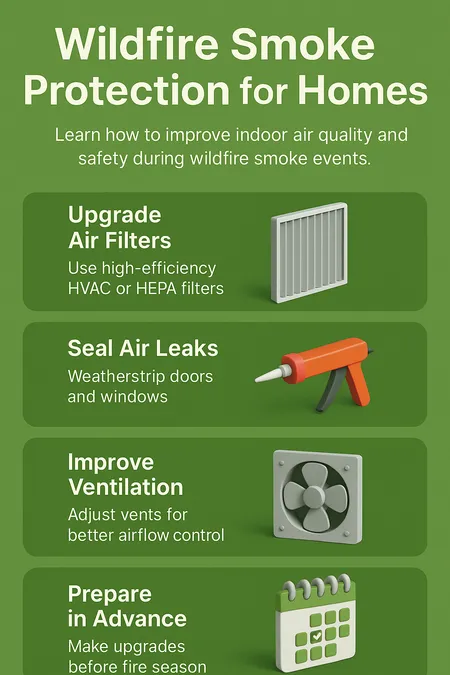
1. Upgrade Your Air Filters
Not all filters are built for smoke. Standard HVAC filters often miss fine particles. For better protection, use a MERV 13 or higher filter in your central system, or a HEPA filter in portable air purifiers. Based on field tests we’ve seen at ShiftHVAC.com, upgrading filters alone can cut indoor smoke particle levels by over 50%.
2. Seal Air Leaks
Smoke doesn’t just come in through open doors or windows—it sneaks in through gaps around vents, utility penetrations, and poorly sealed attic or crawlspace areas. Applying weatherstripping, caulking, and proper insulation reduces these pathways significantly. We’ve worked with homeowners who noticed measurable air quality improvements after sealing just a few overlooked spots.
3. Improve Ventilation Strategies
Ventilation upgrades can make or break indoor air quality during fire season. While it’s smart to close outdoor air intakes during active smoke events, adding systems like energy recovery ventilators (ERVs) or controlled fresh air systems with filtration ensures that your home maintains airflow and humidity balance without pulling in contaminated outdoor air.
Bottom Line:
True wildfire smoke protection isn’t about one quick fix—it’s about combining high-efficiency filtration, tight building seals, and smart ventilation management. This layered approach creates a safer indoor environment, helping you and your family breathe cleaner, healthier air when it matters most.
“Through years of working with homeowners in wildfire-prone areas, we’ve learned that real smoke protection isn’t achieved by a single quick fix. It comes from layering solutions—like MERV 13 filters, precision sealing, and controlled ventilation—that work together to create a safer, healthier home environment.”
Case Study & Real-World Examples
1. California Home: Smoke Reduction Success
- Problem: Family reported persistent smoke indoors despite closed windows.
- Findings: Standard MERV 8 filter + air leaks around attic penetrations.
- Fix: Upgraded to MERV 13 filter + sealed ducts and utility gaps.
- Result: Indoor smoke particles reduced by 65% in 48 hours.
- Family feedback: Cleaner air, kids slept better, fewer coughing fits.
2. Colorado Homes: Creating Clean Zones
- Challenge: No central HVAC, heavy reliance on portable purifiers.
- Solution: Placed HEPA purifiers in bedrooms + sealed door and window gaps.
- Result: Created safe “clean zones” with healthy air during peak smoke events.
- Benefit: Low-cost, highly effective protection.
3. Research + Field Insights
- EPA confirms: Filtration + sealing = best results.
- Our fieldwork shows:
- Filters alone = limited improvements.
- Sealing alone = partial relief.
- Layered approach (filters + sealing + ventilation) = long-term protection.
- Filters alone = limited improvements.
Supporting Statistics
DIY Air Cleaners Are Effective
- EPA: A box fan + MERV-13 filter can reduce wildfire smoke particles as effectively as many commercial purifiers with similar CADR.
- Source: EPA.gov
- Field note: We’ve seen homeowners build these for under $50 with noticeable air quality improvements.
High-Efficiency Filters Save Lives
- EPA modeling (2003 CA wildfires):
- 47–261 hospital visits prevented.
- 9–52 premature deaths avoided in 10 days with MERV 13+ filters running continuously.
- 47–261 hospital visits prevented.
- Source: EPA.gov PDF
- Field note: Reinforces what we tell clients—filtration is a health safeguard, not just a comfort upgrade.
Wildfire Smoke Impacts Communities Unevenly
- CDC (Oregon 2020 wildfires):
- 30% increase in asthma-related ER visits for Hispanic/Latino residents.
- 22% increase for non-Hispanic residents.
- 30% increase in asthma-related ER visits for Hispanic/Latino residents.
- Source: CDC.gov
- Field note: We’ve observed that underserved households benefit the most from simple solutions like portable HEPA units or DIY purifiers.
Key Takeaway:
Government research and real-world projects confirm it: layered protection with filters, sealing, and ventilation is essential for keeping wildfire smoke out and protecting your family’s health.
Final Thought & Opinion
Protecting your home from wildfire smoke isn’t one fix—it’s a layered strategy:
- Upgrade filters.
- Seal leaks.
- Manage ventilation.
What We See in the Field
- Homes with MERV 13+ filters and sealing show measurable smoke reduction in just days.
- Simple solutions—DIY purifiers, weatherstripping, sealing gaps—often bring big improvements for families without advanced HVAC.
Common Mistake
- Waiting until the smoke season to act.
- By then, supplies run out, contractors are busy, and options shrink.
Our Opinion
- Prepare early to turn your home into a safe haven.
- Small, proactive upgrades deliver the biggest impact when it matters most.
At ShiftHVAC.com, we believe wildfire smoke protection goes beyond comfort. It’s about resilience, health, and peace of mind—and we’ve seen firsthand how layered solutions make that possible.
Frequently Asked Questions (FAQ)
1. How can I protect my home from wildfire smoke?
The most effective approach is layered:
- Upgrade to MERV 13+ or HEPA filters.
- Seal gaps around windows, doors, and ducts.
- Use portable HEPA purifiers in bedrooms and living areas.
- Manage ventilation to keep smoke out while maintaining airflow.
2. Do air filters really help against wildfire smoke?
Yes. High-efficiency filters (MERV 13 or higher) can capture fine smoke particles (PM2.5) that standard filters miss. Portable HEPA purifiers are also effective in creating clean indoor zones.
3. Should I run my HVAC system during a wildfire smoke event?
Yes—with precautions. Run your HVAC system on recirculation mode with a high-efficiency filter installed. Avoid pulling in outdoor air unless your system has advanced filtration.
4. Are DIY air purifiers effective?
Yes. Studies by the EPA show that a box fan paired with a MERV-13 filter can reduce smoke particles as effectively as some commercial units with similar Clean Air Delivery Rates (CADR).
5. When should I prepare my home for wildfire smoke?
Start before wildfire season. Supplies like filters, purifiers, and weatherstripping often sell out quickly once fires begin. Early preparation ensures your home is ready when smoke levels rise.